
Cancer Related Health Inequalities VCFSE Grant Fund
We’re delighted to launch a second round of the Cancer related Health Inequalities VCFSE Grant Fund!
This fund offers small grants of up to £5,000 (or up to £15,000 if working with 2 other organisations) to support Voluntary, Community, Faith and Social Enterprise (VCFSE) organisations working to address and reduce cancer related health inequalities. Grants are available for projects that remove barriers or make it easier for people to get cancer care and support at any stage.
Let’s work together to make cancer care fairer and more accessible for everyone.
Why this fund is important
Cancer affects more people every year, and not everyone has the same access to care or support. Health inequalities exist at every stage – from prevention to diagnosis to treatment to survivorship to end of life care. We need to act now, with VCFSE organisations playing a vital role, being uniquely placed to help address these challenges at a local level.

Context
Nationally, over 3 million people in the UK are currently living with cancer. This number is projected to rise to 5.3 million by 2040. In Lincolnshire, more than 37,000 people are living with cancer, expected to increase to 45,400 by 2030.
Thanks to advances in screening, diagnostics and treatment, cancer survival is at its highest ever! However, a diagnosis still has a profound impact on a person’s mental health, physical wellbeing, and quality of life. People living in rural and coastal areas face additional barriers, such as long travel times, limited access to services and a lack of adequate information to support recovery and long-term health. Recent evidence shows that rural cancer survivors often don’t receive adequate support for managing life after treatment.
In Lincolnshire, the life expectancy gap between the most and least deprived communities is 7-9 years, and cancer is a major reason for this gap. That’s why cancer is a key focus of the Core20Plus5 approach to tackling health inequalities.
VCFSE organisations are vital in helping communities overcome these barriers!
Areas of Focus
This grant fund focuses on three key areas. Projects aren’t expected to fully solve these challenges, but take steps towards addressing them.
For all areas of focus, support people from Lincolnshire’s most deprived (20%) communities who are in a health inclusion group. We would particularly welcome applications focusing on older adults over 65, people with learning disabilities and Gypsy, Roma and Traveller communities.
1. Access to Diagnostics (Tests) – We are particularly interested in applications on this key area for the second round of funding.
Support people to get cancer tests and screenings. This could include help with transport or associated costs (such as public transport costs, car parking vouchers) or finding other ways to make early diagnosis easier.
2. Access to cancer treatment – We are particularly interested in applications on this key area for the second round of funding.
Support people to get cancer treatment. This could include help with transport (as above) or any other creative solutions that make it easier for people to attend appointments and receive care.
3. Survivorship
Support people to live well with and beyond cancer. This could include prehabilitation (support before treatment starts), financial advice or support, holistic needs assessment, fitness / wellbeing groups, peer / community support groups.
Data to help shape your thinking
Understanding the local context is key.
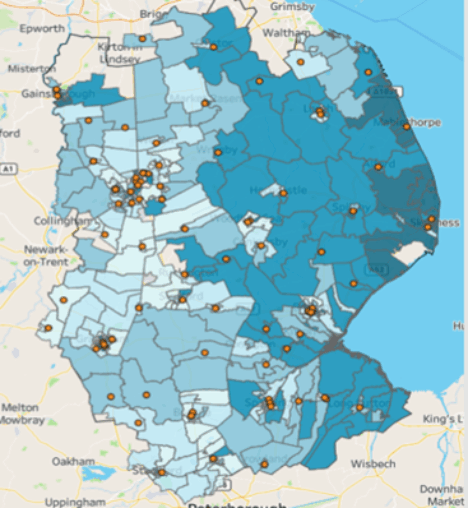
This fund will focus on the most deprived 20% areas in Lincolnshire (IMD1&2). These areas are shown in darker blue on the heat map.
We are particularly interested in applications focusing in rural and coastal communities for the second round of funding.
Cancer and deprivation
68% of cancer patients in Lincolnshire live in middle or high deprivation areas. Nearly 80% of cancer patients also have another long-term condition, adding to the complexity of their care needs.
In addition, this presentation here has further context that was shared at the Q&A sessions.
What are the key challenges we know about?
These are some of the known challenges and barriers faced by people in Lincolnshire’s most deprived communities. Your project doesn’t need to address all of them, but it should aim to tackle at least one.
1. Transport
In Lincolnshire, some people travel up to 2 hours to reach hospital appointments or treatment. For some diagnostic tests, there is extensive travel. This can delay diagnosis and lead to poorer outcomes.
2. Low literacy levels
In some areas of Lincolnshire, the average reading age is 7-10 years, meaning appointment letters and health information may not be understood.
3. Equitable access
People in rural areas may struggle to access palliative and end-of-life care because of other commitments (e.g. childcare, pet care, other caring responsibilities), and carers may face loneliness and isolation.
4. Stigma and Discrimination
There is growing evidence that stigma can prevent cancer survivors in rural areas from fully reintegrating into their communities.
5. Digital Inequalities
Limited access to digital tools and skills can stop people from finding information, advice and support online, making self-management harder.
6. Financial Inequalities
Some cancer patients face fuel poverty, water poverty and other financial pressures that affect their health and wellbeing.

How much is available?
Grants of up to £5,000 are available. Projects are between 3-6 months (a maximum of 6 months) in length. The total amount available for the second round is around £50,000.
You may make a joint application with either 1 or 2 other VCFSE organisations for a total of £10,000 or £15,000 respectively, if a partnership approach will add value to your proposal.
You may have seen our Health Inequalities VCFSE Grant Fund where we are piloting a collaborative approach. As that is an ongoing pilot, this fund will follow a more traditional method of funding.
What can the money be used for?
This grant may be used to:
· Expand something you already do, perhaps offering it in other places or at different times to meet changes in demand
· Develop and test something new on a small scale
· Sustain existing provision that may otherwise close (yes, it can cover core costs!).
What can’t the money be used for?
· Non-cancer related projects
· People living outside of Lincolnshire
· Applications from non VCFSE organisations
How do I apply?
The closing date for for the second round of applications is 9am on Monday 3rd November. You will be notified of the outcome of your application by Friday 14th November.
The application form is a word document (below) and submitted via email to Emily.ward@lvet.org.

Want to ask a question?
We’re running two Q&A sessions over Microsoft Teams – no registration necessary, just drop in!
Tuesday 14th October 2025 at 11.30am – 12.30pm – Join the meeting now
Thursday 16th October 2025 at 2pm – 3pm – Join the meeting now
This page will be updated after each session.
Timeline
Fund Launch (Round 2) – Tuesday 7th October 2025
Q&A sessions – 14th October and 16th October 2025
Closing date for applications – 9am on Monday 3rd November 2025
Application panel – Week commencing 10th November 2025
Feedback to applicants – By Friday 14th November 2025
Projects start date – 1st December 2025 (flexible within reason)
The application form is a word document (below) and submitted via email to Emily.ward@lvet.org.
If you have any questions or would like to discuss anything further, please do get in touch by emailing hello@lvet.org